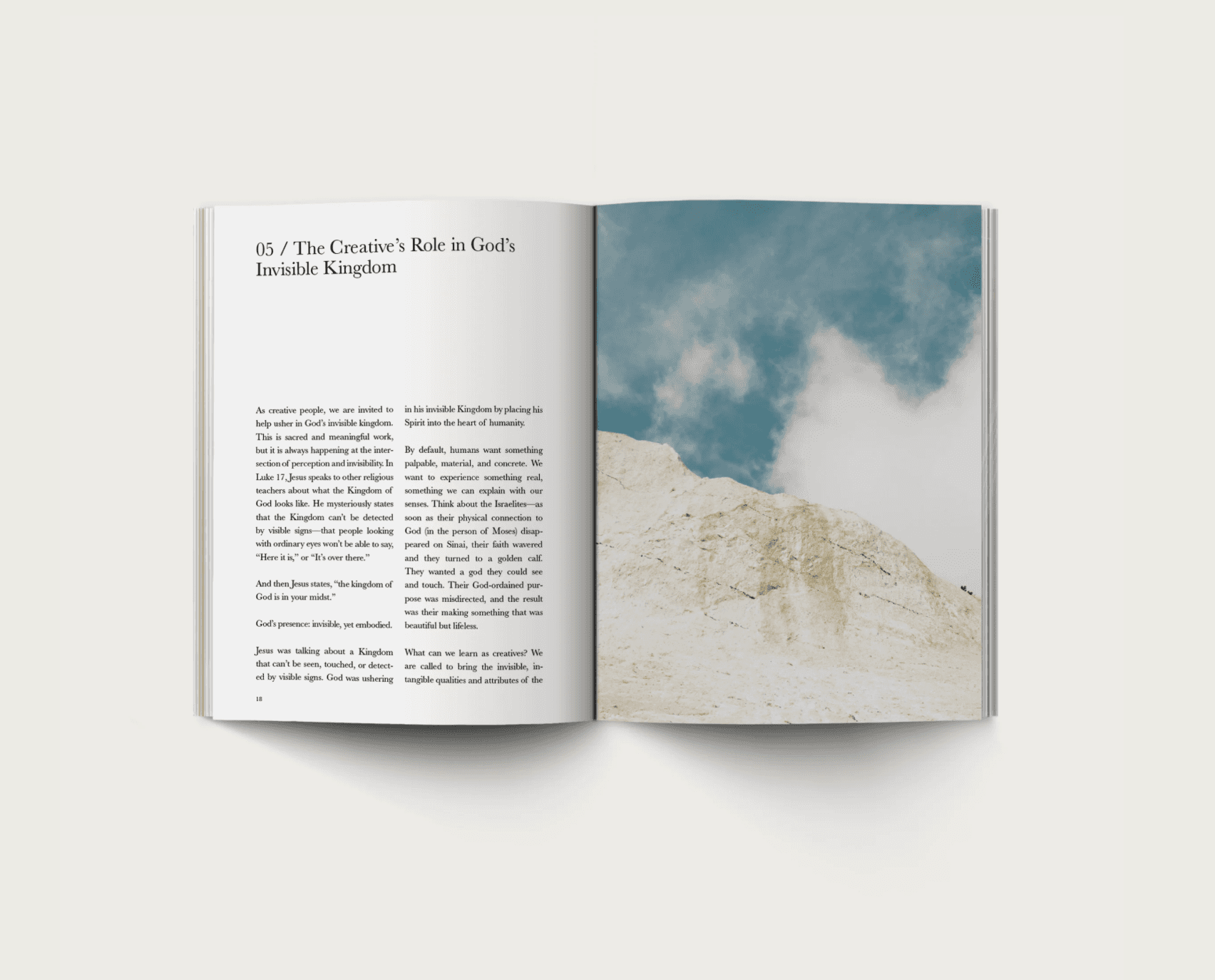

Excellence in design is an act of stewardship — of the content, of the reader's attention, and of the resources invested in creating the material.
For churches, ministries, and faith-based organizations that publish printed resources — books, study guides, devotionals — design is not a finishing touch. It is a form of hospitality that makes room for the reader by removing friction.
This piece is for leaders and communicators in ministry contexts who produce printed or published work and want to understand how professional design can elevate the impact of what they've written.
Why Design Matters for Ministry Publications
Consider the last book that genuinely moved you. Chances are, the physical experience of reading it — the weight of the paper, the size of the typeface, the space on the page — contributed to that experience in ways you didn't consciously register. Design either creates friction or removes it. A poorly designed book adds friction and makes the reader work harder. A well-designed one gets out of the way, allowing for full immersion.
For ministry publications, the stakes are even higher. You are asking your reader to engage with material that is spiritually significant, emotionally challenging, or devotionally demanding. The last thing you want is a layout that makes that harder.
Professional design for ministry publications signals something important: this content is worth your time, and we've treated it accordingly.
What "Professional Design" Actually Means for a Publication
Many ministry teams assume professional design means expensive. It doesn't. It means intentional — and it means getting the fundamentals right.
Typography
Typography is the foundation of a readable publication. This means:
Type size and leading (line spacing) appropriate for the reading context and audience. A devotional read in morning quiet time calls for generous spacing. A study Bible note calls for something denser.
A hierarchy that makes the structure of each page immediately legible: what's the chapter title, what's the section heading, what's the body text, what's a callout or scripture reference.
Typefaces that carry the right personality. For most ministry publications, this means something grounded, readable, and warm — not trendy, not generic.
Layout and Grid
A grid is an invisible structure that creates visible consistency. Margins, columns, and spacing should be deliberate — not the defaults of whatever word processor was used to draft the manuscript.
Proper margins matter, especially for books: the inner margin (gutter) needs extra space to accommodate binding. The outer margin should be wide enough for the eye to rest. Too-narrow margins are one of the most immediate signals of an amateur publication.
Cover Design
For any publication that will be distributed, sold, or gifted, the cover is doing real work before a single page is opened. A cover that conveys credibility, matches the content's tone, and stands out in digital and physical environments is worth the investment.
This is especially true for churches and ministries that distribute materials to new visitors, potential donors, or partner organizations. First impressions compound.
Consistency
Every design decision in a publication should follow from the same set of rules. Chapter openers look the same. Pull-out quotes are formatted the same way. Scripture references use the same style. This consistency creates a sense of calm professionalism that the reader absorbs without consciously noticing it.
When consistency breaks down — when chapter 3 looks different from chapter 7 for no clear reason — it introduces friction. The reader may not be able to name it, but they feel it.
Common Mistakes Ministry Teams Make
Using Microsoft Word as a layout tool. Word is a word processor. It is not a page layout application. Documents formatted in Word and sent directly to print almost always have typography, margin, and spacing issues that a layout application would resolve. For anything beyond a simple one-page handout, consider professional layout software or a designer.
Choosing fonts for their look rather than their function. A font that looks elegant at large size on a slide may be nearly unreadable at body copy size in print. Typography decisions for print require testing in print, not just on screen.
Neglecting the cover because the content is "what matters." The content is what matters. The cover is what gets the content in front of the reader. Both deserve attention.
Rushing the proofing stage. Design errors caught before a print run are free to fix. Design errors caught after 5000 copies are printed are not. Build proofing rounds into your timeline, and proof on printed paper, not just on screen.
Design as Stewardship
For organizations working from a Kingdom perspective, how we present our work is part of the work. Excellence in design is an act of stewardship — of the content, of the reader's attention, and of the resources invested in creating the material.
A devotional that is difficult to read, cheaply presented, or visually inconsistent is not a humble publication. It is an underinvested one. The people you're trying to reach deserve the clearest, most beautiful version of what you have to say.
Design, done well, is a form of care.
Horsfall Design Co. helps churches, ministries, and faith-based organizations design publications that honor their content and serve their readers. Book a fit-check call to talk about your next project.
Check out our FAQ for some answers to common questions or ask us directly via our contact page!
(Photo courtesy of "All That Is Made" by Alabaster Co.)

Let’s keep in touch.
Discover more about high-performance web design. Follow us on Twitter and Instagram.

